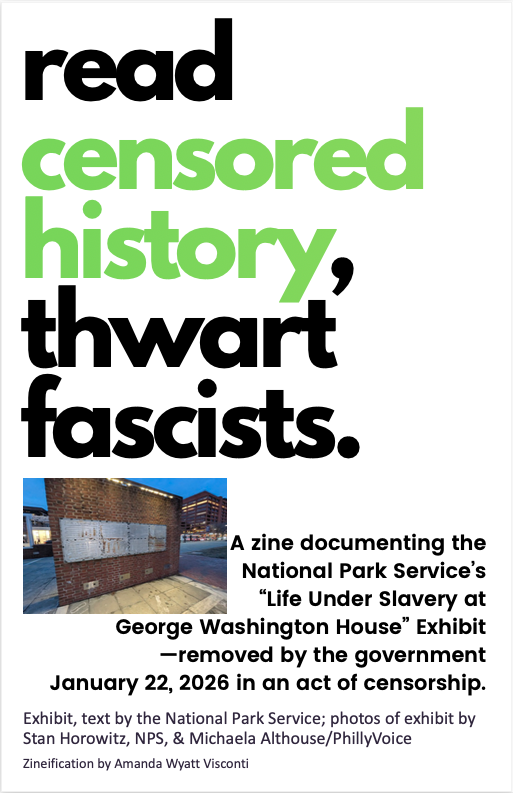
<?xml version="1.0" encoding="utf-8"?><feed xmlns="http://www.w3.org/2005/Atom" ><generator uri="https://jekyllrb.com/" version="3.10.0">Jekyll</generator><link href="https://literaturegeek.com/feed.xml" rel="self" type="application/atom+xml" /><link href="https://literaturegeek.com/" rel="alternate" type="text/html" /><updated>2026-03-23T23:23:28+00:00</updated><id>https://literaturegeek.com/feed.xml</id><title type="html">Literature Geek</title><subtitle>Dr. Amanda Wyatt Visconti&apos;s research blog for digital humanities scholarship</subtitle><author><name>Dr. Amanda Wyatt Visconti</name><email>amandavisconti@gmail.com</email></author><entry><title type="html">a zine: ‘read censored history, thwart fascists.’</title><link href="https://literaturegeek.com/made/2026/01/27/M-read-censored-history.html" rel="alternate" type="text/html" title="a zine: ‘read censored history, thwart fascists.’" /><published>2026-01-27T00:00:00+00:00</published><updated>2026-01-27T00:00:00+00:00</updated><id>https://literaturegeek.com/made/2026/01/27/M-read-censored-history</id><content type="html" xml:base="https://literaturegeek.com/made/2026/01/27/M-read-censored-history.html"><![CDATA[<p>I just published a <a href="https://zinebakery.com/bakeshop/censoredexhibit">64-page standard-size, full-color zineication</a>, <em>read censored history, thwart fascists</em>, documenting the National Park Service’s “Life Under Slavery at George Washington House” Exhibit—removed by the government January 22, 2026 in an act of censorship.</p>

<p>For more info or to read, download, print the zine (all free!), visit <a href="https://zinebakery.com/bakeshop/censoredexhibit">ZineBakery.com/bakeshop/censoredexhibit</a>.</p>

<p><a href="https://zinebakery.com/bakeshop/censoredexhibit"><img src="https://zinebakery.com/assets/homemade-zines/bakeshop-zines/ReadCensoredHistoryNo1-ViscontiEtAl/zine-pages/1.png" alt="&quot;read censored history, thwart fascists.&quot; zine page 1" /></a></p>]]></content><author><name>Dr. Amanda Wyatt Visconti</name><email>amandavisconti@gmail.com</email></author><category term="made" /><category term="building-making-creating-coding" /><category term="letterpress-book-arts" /><category term="zines" /><category term="social-justice" /><category term="GLAM" /><summary type="html"><![CDATA[I just published a 64-page standard-size, full-color zineication, read censored history, thwart fascists, documenting the National Park Service’s “Life Under Slavery at George Washington House” Exhibit—removed by the government January 22, 2026 in an act of censorship.]]></summary></entry><entry><title type="html">I was awarded a monthlong funded fellowship &amp;amp; artist residency at the Penland School of Craft.</title><link href="https://literaturegeek.com/update/2026/01/01/M-penland-winter-residency-fellowship-2026.html" rel="alternate" type="text/html" title="I was awarded a monthlong funded fellowship &amp;amp; artist residency at the Penland School of Craft." /><published>2026-01-01T00:00:00+00:00</published><updated>2026-01-01T00:00:00+00:00</updated><id>https://literaturegeek.com/update/2026/01/01/M-penland-winter-residency-fellowship-2026</id><content type="html" xml:base="https://literaturegeek.com/update/2026/01/01/M-penland-winter-residency-fellowship-2026.html"><![CDATA[<p>I was awarded a monthlong artist residency &amp; funded fellowship at the <a href="https://penland.org/">Penland School of Craft</a>, one of the oldest and most prestigious handicraft schools in the U.S. The residency took place January 2026.</p>]]></content><author><name>Dr. Amanda Wyatt Visconti</name><email>amandavisconti@gmail.com</email></author><category term="update" /><category term="building-making-creating-coding" /><category term="letterpress-book-arts" /><summary type="html"><![CDATA[I was awarded a monthlong artist residency &amp; funded fellowship at the Penland School of Craft, one of the oldest and most prestigious handicraft schools in the U.S. The residency took place January 2026.]]></summary></entry><entry><title type="html">What is #DHMakes Now?</title><link href="https://literaturegeek.com/2025/12/31/what-is-dhmakes-now" rel="alternate" type="text/html" title="What is #DHMakes Now?" /><published>2025-12-31T00:00:00+00:00</published><updated>2025-12-31T00:00:00+00:00</updated><id>https://literaturegeek.com/2025/12/31/what-is-dhmakes-now</id><content type="html" xml:base="https://literaturegeek.com/2025/12/31/what-is-dhmakes-now"><![CDATA[<p>The #DHmakes community has continued to blossom and expand since our 2024 explainer (below). 2025 saw:</p>
<ul>
  <li>an increase in the number of practitioners posting to the #DHmakes hashtag (see <a href="https://tinyurl.com/DHMakesFeed">the feed at tinyurl.com/DHMakesFeed</a>!) as well as the variety of methods discuss</li>
  <li>4 more public <a href="https://amandavisconti.github.io/DHMakesMethodz/">#DHmakes Methodz talks</a>, with zines documenting the talks to come</li>
  <li>2 scholarly conference sessions (DH2025 and ACH 2025)</li>
  <li>#DHmakes work whose full process was live-documented finishing as published work &amp; competitive award winners (Sara Arribas Colemenar’s <em>String Data Art: the Social Network Analysis of Concurso de Cante Jondo (1922)</em> and Scholars’ Lab <a href="https://scholarslab.lib.virginia.edu/work/string-art-visualization-data-artist/">Data Artist award</a></li>
  <li>Further experimenting with peer review (my 120+ pages of letterpress tutorial zines completing peer review for the Spring 2026 <em>Feminist Media Histories</em> journal special edition on “Craftwork in the Digital”)</li>
  <li>exciting news for community members (e.g. launch of Quinn Daedel’s second makerspace, the YarnLab, a new space separate from their Stanford Textile Makerspace; sustainable infrastructural funding for Ryan Cordell’s Skeuomorph Press)</li>
  <li>more things I’m surely forgetting (let me know!) as that’s the nature of a distributed community initiative :)<br />
And most importantly, a lot of joy, advocacy, learning, and community building.</li>
</ul>

<p><img src="/assets/post-media/2025-12-31-what-is-dhmakes-now/osis-post.png" alt="Screenshot of Francis Osis Bluesky post that says &quot;I had no space to tag #DHMakes above but what an incredible community of people, making fantastic things.&quot;" /></p>

<p>Curious about art, craft, making and want a supportive community, source or asking questions and sharing work, cool inspiration and neat work photos in your life? (Or do this work already and want to get more involved?) The post is below is by <a href="https://bsky.app/profile/literaturegeek.bsky.social">Amanda</a>, <a href="https://bsky.app/profile/claudiaeberger.bsky.social">Claudia</a>, and <a href="https://bsky.app/profile/quinnanya.me">Quinn</a>—a few of the many #DHmakes community members, who’ve described the community in a couple places. We’re gathering those descriptions into one post (though a hashtag in use across multiple platforms is defined by its users, so we aren’t the authority, and its use will evolve over time!).</p>

<p><img src="/assets/post-media/2025-12-31-what-is-dhmakes-now/zine-page-1.png" alt="Screenshot of page from a DHMakes Methodz Zine" /></p>

<p><img src="/assets/post-media/2025-12-31-what-is-dhmakes-now/zine-page-2.png" alt="Screenshot of page from a DHMakes Methodz Zine" /></p>

<ol>
  <li><strong>DH</strong> = digital humanities (folks using or building digital tools like websites, code, VR to explore humanities areas like culture, history, art, ethics; folks using those kinds of humanities approaches to critique technology)</li>
  <li><strong>Makes</strong> = craft, making, makerspace types of creative work</li>
</ol>

<p>We published a peer-reviewed article in the <em>Korean Journal of Digital Humanities</em>,<a href="https://accesson.kr/kjdh/v.1/1/73/43507">”#DHmakes: Baking Craft into DH Discourse”</a>, if you want to know a lot about the community’s origins, history, and outputs.</p>

<p><strong>If you want a ✨tl;dr✨ though, here’s a FAQ!</strong></p>

<p><strong>Who started this?</strong><br />
We’re digital humanities people who incorporate physical making/art into our work (or do it as a hobby and share it online somewhere)!</p>

<p><strong>Who is this for?</strong> <br />
#DHmakes is loosely folks in digital humanities/libraries/academia/learning-work who craft/make (including as non-job hobby), open to anyone interested.</p>

<p><strong>What kinds of things get posted?</strong></p>

<ul>
  <li>“I made/am making a thing!”</li>
  <li>work related to including craft/textile work in making</li>
  <li>works-in-progress, fails, public figuring-out how to do some method/project</li>
  <li>explicitly celebrating, amplifying, encouraging neat craft/make work, whether or not the creators are digital humanities people</li>
  <li>encouraging sharing “this is my hobby, not my job” crafts</li>
  <li>getting started</li>
</ul>

<p><strong>What kinds of making/crafting?</strong><br />
All of them? We’re interested in an expansive definition and especially things that have sometimes gotten left out of how people think of makerspaces/making, such as textile art. Other frequent areas of interest tagged #DHmakes include craft/making work related to:</p>

<ul>
  <li>history</li>
  <li>culture &amp; pop culture</li>
  <li>zines</li>
  <li>data visualization &amp; embodiment, including personal data</li>
  <li>queer/feminist/critical tech, social justice</li>
  <li>play with historical craft practices</li>
  <li>expansive definitions of making that assert awesomeness of areas like fabric arts, cooking, fashion</li>
</ul>

<p>For examples, check out Quinn’s <a href="https://textilemakerspace.stanford.edu/">Textile Makerspace</a>, Claudia’s and Gabby Evergreen’s “<a href="https://storymaps.arcgis.com/stories/9f1d23f02fa8483f884c1b6d20bf0762">Pockets of Information</a>”, Jacqueline Wernimont’s “<a href="https://jwernimont.com/visualizing-energy-data-or-visceralizing-energy-transitions/">Visualizing Energy Data or Visceralizing Energy Transitions</a>”, and Amanda’s <a href="https://scholarslab.lib.virginia.edu/tags/expansive-makerspace">Scholars’ Lab “expansive makerspace”-tagged posts page</a>.</p>

<p><strong>Why have I been tagged #DHmakes?</strong><br />
Folks RT/repost cool, relevant craft/making work with the tag so others get to admire them too.</p>

<p><strong>Am I “DH enough” to use the hashtag?</strong><br />
The “DH” in #DHmakes is digital humanities. We’re guessing the other most active hashtag users agree with us: anyone curious about DH (not necessarily “experienced” or in a “DH job”) should participate! Workers, students, hobbyists in areas like gallery/library/archive/museum/learning that are DH or feel adjacent too.</p>

<p><strong>Have you done things beyond using a hashtag?</strong><br />
Yes!</p>

<ul>
  <li>A <a href="http://textilemakerspace.stanford.edu/dhmakes2023">collaborative making project</a> as part of a conference session (ACH 2023) plus <a href="https://textilemakerspace.stanford.edu/blog/dhmakes-at-ach2023/">a blog post</a> explaining the different crafts/crafters included</li>
  <li>A mini-conference (at DH 2024)</li>
  <li>A journal special issue: <a href="https://dhandlib.org/2024/04/29/making-research-tactile-critical-making-and-data-physicalization-in-digital-humanities/"><em>dh+lib</em> Critical Making Special Issue</a></li>
  <li>A peer-reviewed journal article: <a href="https://accesson.kr/kjdh/v.1/1/73/43507">”#DHmakes: Baking Craft into DH Discourse”</a></li>
  <li>Series of public “intro to x method” talks (<a href="https://amandavisconti.github.io/DHMakesMethodz/">#DHmakes Methodz Talks</a>, Fall 2024)</li>
</ul>

<p>You can follow #DHmakes using <a href="https://bsky.app/profile/literaturegeek.bsky.social/feed/aaadokeexl2vo">a feed of all tagged posts</a>, or a feed of <a href="https://bsky.app/profile/literaturegeek.bsky.social/feed/aaadf5zqsbq24">just the #DHmakes posts that include photos</a>.</p>

<p><img src="/assets/post-media/2024-09-26-what-is-dhmakes-hashtag/dhmakes-banner.png" alt="A banner logo image that shows a cartoon of a groovy skeleton wearing sunglasses, holding a laptop in one hand and a ball of yarn and knitting needle in the other, with the #DHmakes hashtag written underneath" />
<img src="/assets/post-media/2024-09-26-what-is-dhmakes-hashtag/dhmakes-chomp.png" alt="A logo image that shows a cartoon of a groovy skeleton head wearing sunglasses and a blue knit beanie, holding a ball of pink yarn between its skeletal hands and chomping into it; in the background is blurred-out code text, and the #DHmakes hashtag is written at the top" />
<img src="/assets/post-media/2024-09-26-what-is-dhmakes-hashtag/dhmakes-ach2023.jpg" alt="Photo of a full-size skeleton model, Quinn Daedel's &quot;Dr. Cheese Bones&quot;, with one hand up waving, wearing a denim vest decorated with various small crafting projects made by multiple members of the #DHmakes community including a felted &quot;ACH&quot; patch and a tiny data visualization quilt patch" /></p>]]></content><author><name>Amanda Wyatt Visconti</name></author><category term="essay" /><category term="makerspace" /><category term="expansive-makerspace" /><category term="about-collaboration-community" /><category term="about-social-media" /><category term="social media" /><summary type="html"><![CDATA[The #DHmakes community has continued to blossom and expand since our 2024 explainer (below). 2025 saw: an increase in the number of practitioners posting to the #DHmakes hashtag (see the feed at tinyurl.com/DHMakesFeed!) as well as the variety of methods discuss 4 more public #DHmakes Methodz talks, with zines documenting the talks to come 2 scholarly conference sessions (DH2025 and ACH 2025) #DHmakes work whose full process was live-documented finishing as published work &amp; competitive award winners (Sara Arribas Colemenar’s String Data Art: the Social Network Analysis of Concurso de Cante Jondo (1922) and Scholars’ Lab Data Artist award Further experimenting with peer review (my 120+ pages of letterpress tutorial zines completing peer review for the Spring 2026 Feminist Media Histories journal special edition on “Craftwork in the Digital”) exciting news for community members (e.g. launch of Quinn Daedel’s second makerspace, the YarnLab, a new space separate from their Stanford Textile Makerspace; sustainable infrastructural funding for Ryan Cordell’s Skeuomorph Press) more things I’m surely forgetting (let me know!) as that’s the nature of a distributed community initiative :) And most importantly, a lot of joy, advocacy, learning, and community building.]]></summary></entry><entry><title type="html">Brighter Social Media Skies: Bluesky For Library-Worker (and DH!) Online Community</title><link href="https://literaturegeek.com/bluesky-for-academics-video" rel="alternate" type="text/html" title="Brighter Social Media Skies: Bluesky For Library-Worker (and DH!) Online Community" /><published>2025-12-14T00:00:00+00:00</published><updated>2025-12-14T00:00:00+00:00</updated><id>https://literaturegeek.com/bluesky-for-academics-video</id><content type="html" xml:base="https://literaturegeek.com/bluesky-for-academics-video"><![CDATA[<p>Social media can help you build professional and social community, find jobs, learn from others, share your work, ask questions, and hear about new ideas and projects. After the implosion of multiple other social platforms, the Bluesky platform has become one of the best options to keep accessing those benefits. This video captures a live webinar from May I gave for <a href="https://metro.org/">the Metropolitan New York Library Council</a>, aiming to help library and archives workers considering trying out Bluesky, or who’ve dipped a toe in but not felt comfortable using it yet.</p>

<p>All the resources mentioned in this talk are listed at <a href="https://tinyurl.com/intro-bluesky">tinyurl.com/intro-bluesky</a>. Most useful is my <a href="https://tinyurl.com/DHBluesky">Bluesky for Academics</a> guide at <a href="https://tinyurl.com/DHBluesky">tinyurl.com/DHBluesky</a>, which remains regularly updated and contains both very-quick cheatsheet and incredibly detailed versions of how to get started understanding Bluesky use for DHers, GLAM folks, and other knowledge work folks. At the end of that guide is a sortable list of “starter packs”, feeds, and lists gathering folks to follow on Bluesky around topics like DH, critical tech, expansive making &amp; crafting, queer studies, social justice work, and more.</p>

<iframe width="560" height="315" src="https://www.youtube.com/embed/98_ao4nSaS8?si=G25y3n-RShmA42zP" title="YouTube video player" frameborder="0" allow="accelerometer; autoplay; clipboard-write; encrypted-media; gyroscope; picture-in-picture; web-share" referrerpolicy="strict-origin-when-cross-origin" allowfullscreen=""></iframe>]]></content><author><name>Amanda Wyatt Visconti</name></author><category term="talk" /><category term="meta-dh" /><category term="digital-humanities" /><category term="slab" /><category term="advice-tutorial" /><category term="grad-advice" /><summary type="html"><![CDATA[Social media can help you build professional and social community, find jobs, learn from others, share your work, ask questions, and hear about new ideas and projects. After the implosion of multiple other social platforms, the Bluesky platform has become one of the best options to keep accessing those benefits. This video captures a live webinar from May I gave for the Metropolitan New York Library Council, aiming to help library and archives workers considering trying out Bluesky, or who’ve dipped a toe in but not felt comfortable using it yet.]]></summary></entry><entry><title type="html">Conference paper</title><link href="https://literaturegeek.com/update/2025/12/03/globalDH2026participation.html" rel="alternate" type="text/html" title="Conference paper" /><published>2025-12-03T00:00:00+00:00</published><updated>2025-12-03T00:00:00+00:00</updated><id>https://literaturegeek.com/update/2025/12/03/globalDH2026participation</id><content type="html" xml:base="https://literaturegeek.com/update/2025/12/03/globalDH2026participation.html"><![CDATA[<p>My talk on multilingual digital approaches to critical making and book arts was accepted for the 2026 Global DH conference. <a href="https://literaturegeek.com/multilingual-digital-book-arts">I blogged an annotated version of my abstract</a>.</p>]]></content><author><name>Dr. Amanda Wyatt Visconti</name><email>amandavisconti@gmail.com</email></author><category term="update" /><summary type="html"><![CDATA[My talk on multilingual digital approaches to critical making and book arts was accepted for the 2026 Global DH conference. I blogged an annotated version of my abstract.]]></summary></entry><entry><title type="html">Multilingual digital book arts (&amp;amp; an example accepted conference proposal!)</title><link href="https://literaturegeek.com/multilingual-digital-book-arts" rel="alternate" type="text/html" title="Multilingual digital book arts (&amp;amp; an example accepted conference proposal!)" /><published>2025-12-03T00:00:00+00:00</published><updated>2025-12-03T00:00:00+00:00</updated><id>https://literaturegeek.com/multilingual-digital-book-arts</id><content type="html" xml:base="https://literaturegeek.com/multilingual-digital-book-arts"><![CDATA[<p>I’ve a talk accepted to the <a href="https://msuglobaldh.org/">2026 Global DH conference</a>, and share that proposal here both for its content and as another example of what a conference abstract can look like. I’ve added comments (in ‘'’code formatting’’’) highlighting how the abstract proposal is structured.</p>

<h2 id="not-having-to-ask-critical-humanities-making-zines--analog-tech-for-multilingual-dh"><em>“Not having to ask: critical humanities making, zines, &amp; analog tech for multilingual DH”</em></h2>

<p>In <a href="https://scholarslab.lib.virginia.edu/blog/having-to-ask/">“Having to Ask”</a>, a doctoral colleague [2024-2025 Praxis Fellow <a href="https://scholarslab.lib.virginia.edu/people/amna-irfan-tarar/">Amna Irfan Tarar</a>] writes about othering experiences in DH spaces, such as when staff weren’t sure if a web font used by a team project could correctly render her name in Urdu. I’m developing digital and analog letterpress resources as part of our DH center’s critical humanities makerspace studies. Letterpress moveable type is a pre-digital corollary to multilingual web fonts, and Tarar’s essay reinforced my priority of anyone printing with us being able to print their name—without singling out that name as needing special effort or research.</p>

<p><code>Motivation / underlying research question.</code></p>

<p>This lightning talk covers the DH work I’ve started toward this goal, and will be of interest to scholars curious about: zine creation for teaching, critical humanities making, multilingual DH, accessibility, book arts, and connections between historical/retro tech and current DH methods. I’ll share my first set of moveable non-English type, my forthcoming zine on how to inexpensively create similar type, and an overview of my research into historical and current strategies for fabricating non-Latin type (some of which cannot be segmented into easily interoperable rectangles the way Latin type can). I know there are too many languages for us to complete this goal; while slowly moving toward that vision language by language, I’m also developing some quick hacks to at least slightly improve type accessibility in the mean time, as well as working to replicate how such scripts were historically printed.</p>

<p><code>Specifics on what the talk will cover. Which scholars might want to attend it and why, including showing how that's not limited to e.g. "people who do letterpress" or "makerspace people". Quick note that I understand the most immediate likely challenges to this work.</code></p>

<p>I’ve wanted to contribute to a more multilingual DH, despite my monolingual ability restricting what I can do. My hope is to develop enough type design and fabrication competency to partner with colleagues who have greater language competency than me, and I’m eager to hear advice from session attendees toward this goal.</p>

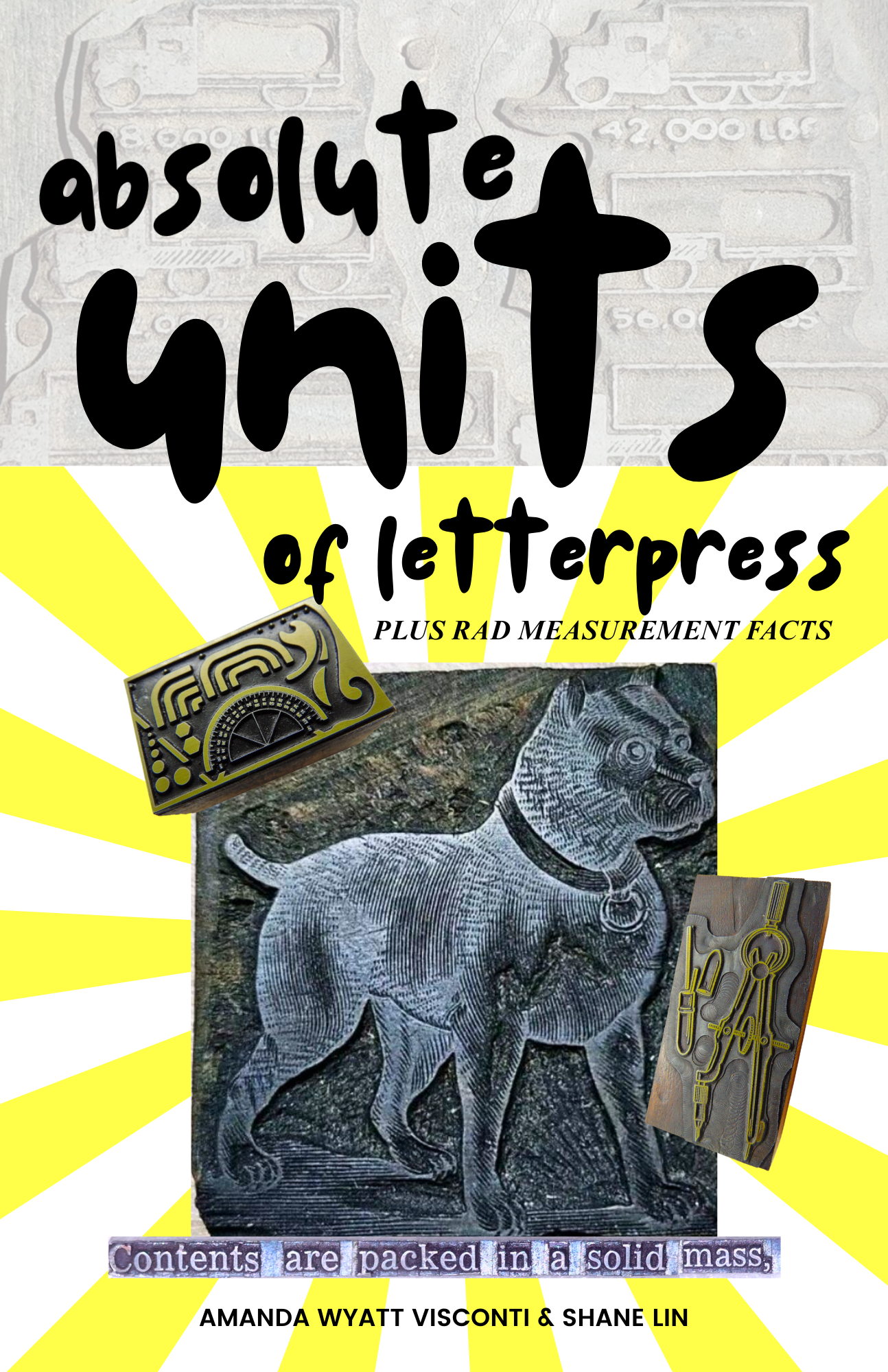
<p><code>Where is this in-progress research headed, and how might that benefit others? What kind of Q&amp;A might this talk elicit from its audience?</code></p>]]></content><author><name>Amanda Wyatt Visconti</name></author><category term="zines" /><category term="meta-dh" /><category term="digital-humanities" /><category term="slab" /><category term="letterpress-book-arts" /><category term="advice-tutorial" /><summary type="html"><![CDATA[I’ve a talk accepted to the 2026 Global DH conference, and share that proposal here both for its content and as another example of what a conference abstract can look like. I’ve added comments (in ‘'’code formatting’’’) highlighting how the abstract proposal is structured.]]></summary></entry><entry><title type="html">a zine: ‘Absolute Units of Letterpress: Plus Rad Measurement Facts’</title><link href="https://literaturegeek.com/made/2025/12/01/M-absolute-units-letterpress-zine.html" rel="alternate" type="text/html" title="a zine: ‘Absolute Units of Letterpress: Plus Rad Measurement Facts’" /><published>2025-12-01T00:00:00+00:00</published><updated>2025-12-01T00:00:00+00:00</updated><id>https://literaturegeek.com/made/2025/12/01/M-absolute-units-letterpress-zine</id><content type="html" xml:base="https://literaturegeek.com/made/2025/12/01/M-absolute-units-letterpress-zine.html"><![CDATA[<p>I just published a <a href="https://zinebakery.com/assets/homemade-zines/bakeshop-zines/AbsoluteUnits-ViscontiLin/AbsoluteUnitsOfLetterpress-ViscontiLin_V1.pdf">20-page standard-size, full-color zine</a>, <em>Absolute Units of Letterpress: Plus Rad Measurement Facts</em>, co-created by me (Amanda Wyatt Visconti) and Shane Lin.</p>

<p>“Absolute Unit”: An entity exceedingly pleasing to the eye &amp; soul by virtue of unusual-for-its-kind square or stocky dimensions. Absolute Units are exemplars of: stability! solidity! abundance! confidence! A model for insisting we deserve at-homeness in our world. A righteous &amp; unbothered certainty &amp; a resistance to being pushed about by others.</p>

<p>This zine spreads a feast of images of letterpress printing block, type, &amp; press Absolute Units; accompanied by 6 mini-essays on neat measurement history and interesting, less-known contemporary measurement facts.</p>

<p>For more info or to read, download, print the zine (all free!), visit <a href="https://zinebakery.com/bakeshop/absoluteunits">zinebakery.com/bakeshop/absoluteunits</a>.</p>

<p><img src="https://zinebakery.com/assets/homemade-zines/bakeshop-zines/AbsoluteUnits-ViscontiLin/cover.png" alt="&quot;Absolute Units of Letterpress: Plus Rad Measurement Facts&quot; zine page 1" /></p>]]></content><author><name>Dr. Amanda Wyatt Visconti</name><email>amandavisconti@gmail.com</email></author><category term="made" /><category term="building-making-creating-coding" /><category term="letterpress-book-arts" /><category term="zines" /><category term="social-justice" /><category term="GLAM" /><summary type="html"><![CDATA[I just published a 20-page standard-size, full-color zine, Absolute Units of Letterpress: Plus Rad Measurement Facts, co-created by me (Amanda Wyatt Visconti) and Shane Lin.]]></summary></entry><entry><title type="html">Grant awarded</title><link href="https://literaturegeek.com/update/2025/09/29/cec-grant-zine-bakery.html" rel="alternate" type="text/html" title="Grant awarded" /><published>2025-09-29T00:00:00+00:00</published><updated>2025-09-29T00:00:00+00:00</updated><id>https://literaturegeek.com/update/2025/09/29/cec-grant-zine-bakery</id><content type="html" xml:base="https://literaturegeek.com/update/2025/09/29/cec-grant-zine-bakery.html"><![CDATA[<p>I received a UVA Library Culture, Engagement, &amp; Community grant to expand the capacity of the <a href="https://zinebakery.com/physical-distro">Zine Bakery @ Scholars’ Lab</a> public distro! Thanks to the grant program, I’ve got some funding to</p>
<ul>
  <li>test out a contraption that makes assembling zines quicker (vs. my tired hands—I’ve folded and stapled over 2.1k zines for SLab since 2024)</li>
  <li>get a copyshop print run of zines to create a deeper backlog ready to refill our racks from as they empty</li>
  <li>bring zines to table at the Charlottesville Zine Fest in October</li>
</ul>

<p><a href="https://zinebakery.com">ZineBakery.com</a> has more info about my multi-part zine collecting, research, and making project.</p>]]></content><author><name>Dr. Amanda Wyatt Visconti</name><email>amandavisconti@gmail.com</email></author><category term="update" /><summary type="html"><![CDATA[I received a UVA Library Culture, Engagement, &amp; Community grant to expand the capacity of the Zine Bakery @ Scholars’ Lab public distro! Thanks to the grant program, I’ve got some funding to test out a contraption that makes assembling zines quicker (vs. my tired hands—I’ve folded and stapled over 2.1k zines for SLab since 2024) get a copyshop print run of zines to create a deeper backlog ready to refill our racks from as they empty bring zines to table at the Charlottesville Zine Fest in October]]></summary></entry><entry><title type="html">How to get and/or print you some zines, for free</title><link href="https://literaturegeek.com/getting-zines" rel="alternate" type="text/html" title="How to get and/or print you some zines, for free" /><published>2025-09-01T00:00:00+00:00</published><updated>2025-09-01T00:00:00+00:00</updated><id>https://literaturegeek.com/getting-zines</id><content type="html" xml:base="https://literaturegeek.com/getting-zines"><![CDATA[<p><strong><em>Direct link to some good culture, tech, and/or social justice</em></strong> <a href="https://airtable.com/appY7WyBFjSzLXQd6/shrPyuB4nbJTqHsbw">zines you can print for free</a></p>

<h2 id="printing-zines-to-read-yourself">Printing zines to read yourself</h2>
<p>I use “free zine” to mean zines you don’t need to pay to access in some way—read online, print copies of to read on paper, and/or get a pre-printed copy of from someone else. Unfortunately, printing is not always free or affordable.</p>

<p>I’m not sure how many libraries offer any free printing these days, but a good library worker will want to help you access info and reading if they can. If you aren’t able to afford printing a zine on your own and your library posts writing saying it charges for printing, you might still ask your local library workers if they know of options, and let them know you’re trying to access zines for reading or learning purposes.</p>

<p>I am not aware of such options at UVA—where I currently work—but I would not necessarily know of any! If you’re near UVA Library—which serves anyone in the region, not just folks studying/working at UVA—consider asking folks at a front desk of one of the libraries, or using the UVA Library homepage’s “Ask a Librarian” chat for questions about community printing (or other topics, especially anything you may feel more comfortable asking online than in person).</p>

<p>Here’s the subset of all my <a href="https://zinebakery.com">Zine Bakery</a> project’s catalogued <a href="https://airtable.com/appY7WyBFjSzLXQd6/shrdTYN1SZtS6WtD2">zines allowing online or printable free access</a>; and here’s the subset of all catalogued <a href="https://airtable.com/appY7WyBFjSzLXQd6/shrPyuB4nbJTqHsbw">zines you can print for free</a>. The difference between the two sets is a small number of zines are free to read online but cannot be downloaded; for example, some are on platforms like Issuu, where there’s some page-turning reading view but download is disabled by the creator.</p>

<h2 id="live-in-or-visiting-charlottesville-pt-1">Live in (or visiting) Charlottesville? Pt 1</h2>
<p>Check out <a href="https://www.thebeautifulidea.gay/">The Beautiful Idea</a>! <em>“A trans-owned antifascist bookstore, queer makers’ market, alternative event space, and radical community hub on the Downtown Mall in Charlottesville, VA… Come in today to find your new favorite read, the perfect gift, or just a safe, friendly place to relax!”.</em></p>

<p>In addition to selling zines (I bought so many zines there first time I went…), they often have free zines as well. And also frequent free community events prioritizing queer folks, community building, community safety and resistance (check <a href="https://www.instagram.com/the.beautiful.idea">their Instagram</a> too).</p>

<h2 id="live-in-or-visiting-charlottesville-pt-2">Live in (or visiting) Charlottesville? Pt 2</h2>
<p>I run a small, free public zine distro in my workplace (the Scholars’ Lab in the University of Virginia’s Shannon Library): <a href="https://zinebakery.com/physical-distro">Zine Bakery @ Scholars’ Lab</a>. Anyone (no UVA affiliation needed) is welcome to take as many zines as they’d like, including multiple copies of the same zine to share with friends, students, etc. These are mostly zines that are free for anyone to print and share, plus some additional zines where the creators have generously allowed us to share copies we print for free from our one location (but you’d otherwise need to pay to access the zine).</p>

<p>We have <em>nothing</em> near to the entire ZB catalog available on our distro racks—these zines are all printed, folded, stapled, and shelved by me during meetings and in random bits of free time (i.e. isn’t my core job), so it’s always a small, rotating selection and can get scant when I’m on vacation, sick, or especially busy.</p>

<p>To make sure I maintain the ability to do this project with as much justice and care as I can manage, that distro is a subset of a larger project (“Zine Bakery @ Scholars’ Lab”, rather than Zine Bakery). That means that the kinds of neutral (is this zine likely of use to folks who tend to visit the library or work with Scholars’ Lab?) and negative (will including this zine in the public distro attract censorship, require closing the distro, imperil lab/library/job?) decisions I make curating that distro don’t impact what I do with the larger project. But do know there are some zines in my catalog the Scholars’ Lab distro does not offer copies of.</p>

<p>(We’re not able to print zines for folks by request, unfortunately.)</p>

<h2 id="free-zines-vs-paying-for-zines">Free zines vs paying for zines</h2>
<p>Art is work, and workers deserve to benefit from their labor. (Everyone deserves a thriving wage regardless of if they “work”, but that’s a tangent I’ll save for elsewhere, other than to ask you if you had a kneejerk response to that, to sit with the large number of jobs that are actively harmful and disrespectful to workers for no reason—e.g. so many retail jobs—and think about what makes forcing people to work in such situations the qualification for deserving and getting a good life.)</p>

<p>I’ve prioritized cataloguing free zines for a number of reasons, including to be able to make them a visible, free part of my library work that anyone can take away to keep. I haven’t yet been able to find or successfully propose a pool of funding to use how I want: toward working with authors of non-free zines around a paid license to distribute physical zines from just our location. If anyone knows of models for that, please do let me know!</p>

<p>Wanting to pay authors/creators, and also wanting to help anyone access information and reading without needing to pay or prove they’re a member of a university, are both important to me. The Zine Bakery distro at Scholars’ Lab is the way I’ve found to balance those goals, using my ability to print some zines as an employe, as well as putting work time and work space toward supporting a distro.</p>

<p>I include direct links to where authors host their zines, rather than rehost them myself—both as an ethical and legal requirement, but also because collecting has historically been (and still is) often extractive work. I want to amplify zines and point people to their authors and websites. I’m hoping to pull out these sites into one webpage in the future that just links to zine authors’ webpages and stores, to amplify those further. I’m hoping to work on more design approaches like that; e.g. a small one is I recently added a bit of code to the top paragraph on my homepage that rotates through names of specific catalogued authors, to try to make it more obvious these zines are not mine.</p>]]></content><author><name>Amanda Wyatt Visconti</name></author><category term="zines" /><summary type="html"><![CDATA[Direct link to some good culture, tech, and/or social justice zines you can print for free]]></summary></entry><entry><title type="html">Interesting digital humanities data sources</title><link href="https://literaturegeek.com/interesting-digital-humanities-data-sources" rel="alternate" type="text/html" title="Interesting digital humanities data sources" /><published>2025-08-26T00:00:00+00:00</published><updated>2025-08-26T00:00:00+00:00</updated><id>https://literaturegeek.com/interesting-digital-humanities-data-sources</id><content type="html" xml:base="https://literaturegeek.com/interesting-digital-humanities-data-sources"><![CDATA[<p>I bookmark sources of data that seem interesting for digital humanities teaching and research:</p>
<ul>
  <li>showing humanists what data &amp; datafication in their fields can look like</li>
  <li>having interesting examples when teaching data-using tools</li>
  <li>trying out new data tools</li>
</ul>

<p>I’m focusing on sharing bookmarks with <strong>data that’s already in spreadsheet or similar structured format</strong>, rather than e.g.</p>
<ul>
  <li>collections of digitized paper media also counting as data and worth exploring, like Josh Begley’s <a href="https://racebox.org/">racebox.org</a>, which links to full PDFs of US Census surveys re:race and ethnicity over the years; or</li>
  <li>3D data, like my colleague <a href="https://tinyurl.com/SLab3DCHI">Will Rourk’s</a> on historic architecture and artifacts, including a local Rosenwald School and at-risk former dwellings of enslaved people</li>
</ul>

<p>Don’t forget to cite datasets you use (e.g. build on, are influenced by, etc.)!</p>

<p>And if you’re looking for community, the <a href="https://openhumanitiesdata.metajnl.com/">Journal of Open Humanities Data</a> is celebrating its 10th anniversary with <a href="https://openhumanitiesdata.metajnl.com/events/anniversary-2025">a free, global virtual event on 9/26</a> including “lightning talks, thematic dialogues, and community discussions on the future of open humanities data”.</p>

<h1 id="data-is-being-destroyed">Data is being destroyed</h1>
<p>U.S. fascists have destroyed or put barriers around a significant amount of public data in just the last 8 months. Check out <a href="https://journeysofdrg.org/2025/03/07/data-interrupted/">Laura Guertin’s “Data, Interrupted” quilt blog post</a>, then the free <a href="https://zinebakery.com/homemade-zines/bakeshop-2-diywebarchiving">DIY Web Archiving zine</a> by me, Quinn Daedel, Tessa Walsh, Anna Kijas, and Ilya Kreymer for a novice-friendly guide to helping preserve the pieces of the Web you care about (and why you should do it rather than assuming someone else will). The <a href="https://www.datarescueproject.org/">Data Rescue project</a> is a collaborative project meant “to serve as a clearinghouse for data rescue-related efforts and data access points for public US governmental data that are currently at risk. We want to know what is happening in the community so that we can coordinate focus. Efforts include: data gathering, data curation and cleaning, data cataloging, and providing sustained access and distribution of data assets.”</p>

<h1 id="interesting-datasets">Interesting datasets</h1>

<h2 id="the-database-of-african-american-and-predominantly-white-american-literature-anthologies"><em>The Database of African American and Predominantly White American Literature Anthologies</em></h2>
<p><em>By Amy Earhart</em></p>

<p>“Created to test how we categorize identities represented in generalist literature anthologies in a database and to analyze the canon of both areas of literary study. The dataset creation informs the monograph <em>Digital Literary Redlining: African American Anthologies, Digital Humanities, and the Canon</em> (Earhart 2025). It is a highly curated small data project that includes 267 individual anthology volumes, 107 editions, 319 editors, 2,844 unique individual authors, and 22,392 individual entries, and allows the user to track the shifting inclusion and exclusion of authors over more than a hundred-year period. Focusing on author inclusion, the data includes gender and race designations of authors and editors.”</p>

<h2 id="national-ufo-reporting-center-tier-1-sighting-reports">National UFO Reporting Center: “Tier 1” sighting reports</h2>
<p>Via Ronda Grizzle, who uses this dataset when teaching Scholars’ Lab graduate Praxis Fellows how to shape research questions matching available data, and how to understand datasets as subjective and choice-based. I know UFOs sounds like a funny topic, and it can be, but there are also lots of interesting inroads like the language people use reflecting hopes, fears, imagination, otherness, certainty. A good teaching dataset given there aren’t overly many fields per report, and those include mappable, timeline-able, narrative text, and a very subjective interesting one (a taxonomy of UFO shapes). <a href="https://nuforc.org/subndx/?id=highlights">nuforc.org/subndx/?id=highlights</a></p>

<h2 id="the-pudding"><em>The Pudding</em></h2>
<p>Well researched, contextualized, beautifully designed data storytelling on fun or meaningful questions, with an emphasis on cultural data and how to tell stories with data (including personally motivated ones, something that I think is both inspiring for students and great to have examples of how to do critically). <a href="https://pudding.cool">pudding.cool</a></p>

<h2 id="and-its-ham4corpus-use">…and its Ham4Corpus use</h2>
<p>Shirley Wu for <em>The Pudding</em>’s <a href="https://pudding.cool/2017/03/hamilton/">interactive visualization of every line in <em>Hamilton</em></a> uses my <a href="https://github.com/amandavisconti/ham4corpus">ham4corpus</a> dataset (and data from other sources), which might be a useful example of how an afternoon’s work with open-access data (Wikipedia, lyrics) and some simple scripted data cleaning and formatting can produce foundations for research and visualization.</p>

<h2 id="responsible-datasets-in-context"><em>Responsible Datasets in Context</em></h2>
<p><em>Dirs. Sylvia Fernandez, Miriam Posner, Anna Preus, Amardeep Singh, &amp; Melanie Walsh</em></p>

<p>“Understanding the social and historical context of data is essential for all responsible data work. We host datasets that are paired with rich documentation, data essays, and teaching resources, all of which draw on context and humanities perspectives and methods. We provide models for responsible data curation, documentation, story-telling, and analysis.” 4 rich dataset options (as of August 2025) each including a data essay, ability to explore the data on the site, programming and discussion exercises for investigating and understanding the data. Datasets: <a href="https://www.responsible-datasets-in-context.com/posts/np-data/">US National park visit data</a>, <a href="https://www.responsible-datasets-in-context.com/posts/gender-violence/">gender violence at the border</a>, <a href="https://www.responsible-datasets-in-context.com/posts/african-american-periodical-poetry/aa-periodical-poetry.html">early 20th-century ~1k poems from African American periodicals</a>, <a href="https://www.responsible-datasets-in-context.com/posts/top-500-novels/top-500-novels.html">top 500 “greatest” novels according to OCLC records on novels most held by libraries</a>. <a href="https://www.responsible-datasets-in-context.com/">responsible-datasets-in-context.com</a></p>

<h2 id="post45-data-collective"><em>Post45 Data Collective</em></h2>
<p><em>Eds Melanie Walsh, Alexander Manshel, J.D. Porter</em></p>

<p>“A peer-reviewed, open-access repository for literary and cultural data from 1945 to the present”, offering 11 datasets (as of August 2025) useful in investigations such as how book popularity &amp; literary canons get manufactured. Includes datasets on “The Canon of  Asian American Literature”, “International Bestsellers”, “Time Horizons of Futuristic Fiction”, and “The Index of Major Literary Prizes in the US”. The project ‘provides an open-access home for humanities data, peer reviews data so scholars can gain institutional recognition, and DOIs so this work can be cited’: <a href="https://data.post45.org/our-data.html">data.post45.org/our-data.html</a></p>

<h2 id="cbp-and-ice-databases">CBP and ICE databases</h2>
<p>Via Miriam Posner: A spreadsheet containing all publicly available information about CBP and ICE databases, from the American Immigration Council <a href="https://www.americanimmigrationcouncil.org/content-understanding-immigration-enforcement-databases/">americanimmigrationcouncil.org/content-understanding-immigration-enforcement-databases</a></p>

<h2 id="data-assignment-in-the-critical-fan-toolkit">Data assignment in <em>The Critical Fan Toolkit</em></h2>
<p><em>By Cara Marta Messina</em></p>

<p>Messina’s project (which prioritizes <em>ethical</em> critical studies of fan works and fandom) includes this <a href="https://www.criticalfantoolkit.org/teaching/resources/activity-fandom-statistics.html">model teaching assignment</a> on gathering and analyzing fandom data, and understanding the politics of what is represented by this data. Includes links to 2 data sources, as well as Destination Toast’s <a href="https://destinationtoast.tumblr.com/post/137065429834/how-do-i-gather-data-about-the-ships-in-my-fandom">“How do I find/gather data about the ships in my fandom on AO3?”</a>.</p>

<p>(Re:fan studies, note that there is/was an Archive of Our Own dataset—but it was created in a manner seen as invasive and unethical by AO3 writers and readers. Good to read about and discuss with students, but I do not recommend using it as a data source for those reasons.)</p>

<h2 id="fashion-calendar-data"><em>Fashion Calendar</em> data</h2>
<p><em>By Fashion Institute of Technology</em></p>

<p><em>Fashion Calendar</em> was “an independent, weekly periodical that served as the official scheduling clearinghouse for the American fashion industry” 1941 to 2014; 1972-2008’s  <em>Fashion International</em> and 1947-1951’s <em>Home Furnishings</em> are also included in the dataset. Allows manipulation on the site (including graping and mapping) as well as download as JSON. <a href="https://fashioncalendar.fitnyc.edu/page/data">fashioncalendar.fitnyc.edu/page/data</a></p>

<h2 id="black-studies-dataverse"><em>Black Studies Dataverse</em></h2>
<p><em>With datasets by Kenton Ramsby et al.</em></p>

<p>Found via Kaylen Dwyer. “The Black Studies Dataverse contains various quantitative and qualitative datasets related to the study of African American life and history that can be used in Digital Humanities research and teaching. Black studies is a systematic way of studying black people in the world – such as their history, culture, sociology, and religion. Users can access the information to perform analyses of various subjects ranging from literature, black migration patterns, and rap music. In addition, these .csv datasets can also be transformed into interactive infographics that tell stories about various topics in Black Studies. “ <a href="https://dataverse.tdl.org/dataverse/uta-blackstudies">dataverse.tdl.org/dataverse/uta-blackstudies</a></p>

<h2 id="netflix-movies--shows">Netflix Movies &amp; Shows</h2>
<p><a href="https://www.kaggle.com/datasets/shivamb/netflix-shows">kaggle.com/datasets/shivamb/netflix-shows</a></p>

<h2 id="billboard-hot-100-number-ones-database"><em>Billboard Hot 100 Number Ones Database</em></h2>
<p><em>By Chris Dalla Riva</em></p>

<p>Via Alex Selby-Boothroyd: <a href="https://docs.google.com/spreadsheets/d/1j1AUgtMnjpFTz54UdXgCKZ1i4bNxFjf01ImJ-BqBEt0/edit?gid=82262432#gid=82262432">Gsheet by Chris Dalla Riva</a> with 100+ data fields for every US Billboard Hot 100 Number One song since August 4th, 1958.</p>

<h2 id="internet-broadway-database"><em>Internet Broadway Database</em></h2>
<p>Found via Heather Froehlich: “provides data, publishes charts and structured tables of weekly attendance and ticket revenue, additionally available for individual shows”. <a href="https://www.ibdb.com">ibdb.com</a></p>

<h2 id="structured-wikipedia-dataset">Structured Wikipedia Dataset</h2>
<p>Wikimedia released this dataset sourced from their “Snapshot API which delivers bulk database dumps, aka snapshots, of Wikimedia projects—in this case, Wikipedia in English and French languages”. “Contains all articles of the English and French language editions of Wikipedia, pre-parsed and outputted as structured JSON files using a consistent schema compressed as zip” <a href="https://huggingface.co/datasets/wikimedia/structured-wikipedia">huggingface.co/datasets/wikimedia/structured-wikipedia</a>. Do note there has been controversy in the past around Hugging Face scraping material for AI/dataset use without author permission, and differing understandings of how work published in various ways on the web is owned. (I might have a less passive description of this if I went and reminded myself what happened, but I’m not going to do that right now.)</p>

<h2 id="corgis-the-collection-of-really-great-interesting-situated-datasets-project"><em>CORGIS: The Collection of Really Great, Interesting, Situated Datasets</em> project</h2>
<p><em>By Austin Cory Bart, Dennis Kafura, Clifford A. Shaffer, Javier Tibau, Luke Gusukuma, Eli Tilevich</em></p>

<p>Visualizer and exportable datasets of a lot of interesting datasets on all kinds of topics.</p>

<h2 id="fivethirtyeights-data">FiveThirtyEight’s data</h2>
<p>I’m not a fan for various reasons, but their data underlying various political, sports, and other stats-related articles might still be useful: [data.fivethirtyeight.com(https://data.fivethirtyeight.com/) Or look at how and what they collect, include in their data and what subjective choices and biases those reveal :)</p>

<h2 id="zine-bakery-zines">Zine Bakery zines</h2>
<p>I maintain <a href="https://zinebakery.com/pages/zines">a database of info on hundreds of zines</a> related to social justice, culture, and/or tech topics for my <a href="https://ZineBakery.com">ZineBakery.com</a> project—with over 60 metadata fields (slightly fewer for the public view) capturing descriptive and evaluative details about each zine. Use the … icon then “export as CSV” to use the dataset (I haven’t tried this yet, so let me know if you encounter issues).</p>

<h2 id="openalex">OpenAlex</h2>
<p>I don’t know much about this yet, but it looked cool and is from a non-profit that builds tools to help with the journal racket (<a href="https://unsub.org/">Unsub</a> for understanding “big deals” values and alternatvies, <a href="https://unpaywall.org/">Unpaywall</a> for OA article finding). “We index over 250M scholarly works from 250k sources, with extra coverage of humanities, non-English languages, and the Global South. We link these works to 90M disambiguated authors and 100k institutions, as well as enriching them with topic information, SDGs, citation counts, and much more. Export all your search results for free. For more flexibility use our API or even download the whole dataset. It’s all CC0-licensed so you can share and reuse it as you like!” <a href="https://openalex.org">openalex.org</a></p>

<h1 id="bonus-data-tools-tutorials">Bonus data tools, tutorials</h1>

<p>Matt Lincoln’s <a href="https://github.com/mdlincoln/salty">salty</a>: “When teaching students how to clean data, it helps to have data that isn’t too clean already. salty offers functions for “salting” clean data with problems often found in datasets in the wild, such as pseudo-OCR errors, inconsistent capitalization and spelling, invalid dates, unpredictable punctuation in numeric fields, missing values or empty strings”.</p>

<p><a href="https://datasittersclub.github.io/site">The Data-Sitters Club</a> for smart, accessible, fun tutorials and essays on computational text analysis for digital humanities.</p>

<p>Claudia Berger’s <a href="https://scholarslab.lib.virginia.edu/blog/berger-designing-data-viz/">blog post on designing a data physicalization</a>—a data quilt!—as well as the <a href="https://scholarslab.lib.virginia.edu/work/footpath-for-the-people/">final quilt and free research zine</a> exploring the data, its physicalization process, and its provocations.</p>

<p><a href="https://pudding.cool/resources/">The Pudding’s resources for learning &amp; doing data journalism and research</a></p>

<p>See also <a href="https://www.criticalfantoolkit.org"><em>The Critical Fan Toolkit</em></a> by Cara Marta Messina (discussed in datasets section above), which offers both tools and links to interesting datasets.</p>

<h1 id="letterpress-data-not-publicly-available-yet">Letterpress data, not publicly available yet…</h1>
<p>I maintain a database of the letterpress type, graphic blocks/cuts, presses, supplies, and books related to book arts owned by me or by Scholars’ Lab. I have a <a href="https://amandavisconti.github.io/bookarts/pages/specimenbook-table.html">very-in-progress website version</a> I’m slowly building, without easily downloadable data, just a table view of some of the fields.</p>

<p>I also have a slice of this viewable online and not as downloadable data: just a <a href="https://literaturegeek.com/queer-letterpress-collecting-making-post">gallery of the queerer letterpress graphic blocks I’ve collected or created</a>. But I could get more online if anyone was interested in teaching or otherwise working with it?</p>

<p>I also am nearly done developing a database of the former VA Center for the Book: Book Arts Program’s enormous collection of type, which includes top-down photos of each case of type. I’m hoping to add more photos of example prints that use each type, too. If this is of interest to your teaching or research, let me know, as external interest might motivate me to get to the point of publishing sooner.</p>]]></content><author><name>Amanda Wyatt Visconti</name></author><category term="slab-dh" /><category term="best" /><category term="scholarly-web-design-and-coding" /><category term="notes" /><summary type="html"><![CDATA[I bookmark sources of data that seem interesting for digital humanities teaching and research: showing humanists what data &amp; datafication in their fields can look like having interesting examples when teaching data-using tools trying out new data tools]]></summary></entry></feed>